
How Play-Based Learning Builds Confidence and Independence in Early Childhood
When families begin looking for childcare, they often ask practical questions first.
Will my child be safe?
Will they be happy?
Will they be ready for the next stage?
Will they actually learn?
These are important questions. But in early childhood, learning does not look like formal instruction for most of the day. Instead, much of the most meaningful learning happens through play.
At Balgowlah Early Learning, we believe children learn best in an environment that is safe, supportive and responsive to who they are as individuals. Our educational approach is grounded in play-based learning, because play is one of the most natural and effective ways for young children to develop confidence, independence and a strong sense of themselves. BEL’s internal role and program documents explicitly describe a play-based learning environment and learning programs that respond to children’s ideas, strengths and abilities.
What is play-based learning?
Play-based learning is not “just playing” in the casual sense. It is a thoughtful approach where educators create experiences, environments and routines that support children’s development through exploration, choice, curiosity and interaction.
In a quality early learning setting, play gives children the chance to:
investigate ideas
solve problems
communicate with others
make decisions
test their abilities
build resilience through trial and error
BEL’s internal educational program guidance states that the service should facilitate a play-based learning environment and develop learning programs that inspire independent learners. It also links the program to outcomes such as identity, wellbeing, confidence, involvement in learning, and effective communication.
Why confidence grows through play
Confidence in early childhood does not usually come from being told “good job” over and over. Real confidence grows when children experience themselves as capable.
That might look like:
climbing and balancing outdoors
figuring out how to join a group game
choosing materials for creative work
persisting with a puzzle
asking questions
trying again after something does not work the first time
These moments may look simple from the outside, but they are powerful. Through play, children begin to understand:
I can try.
I can participate.
I can make choices.
I can solve problems.
I belong here.
That is why a strong early learning program is not only about activities. It is about creating an environment where children feel supported enough to take small, meaningful risks in their learning.
BEL’s internal documents describe the environment as one that should be safe, supportive, stimulating and educational, and one that promotes exploration and play-based learning.
How play supports independence
Independence in early childhood does not mean expecting children to do everything alone. It means helping them gradually build the skills and confidence to participate more actively in their daily lives.
Through play-based learning, children begin to develop independence by:
making choices
managing simple routines
expressing preferences
caring for materials
practising self-help skills
learning to work alongside others
Educators play an important role here. A thoughtful educator does not rush in too quickly or control every outcome. Instead, they guide, observe, encourage and create the right balance of support and challenge.
BEL’s internal program guidance emphasises that the educational program should be based on knowledge of each individual child, and that educators should design learning that enhances and extends each child’s development through observation, planning, implementation and reflection.
Play also builds communication and social capability
One of the biggest benefits of play-based learning is that children are constantly practising communication.
They negotiate.
They take turns.
They explain ideas.
They ask for help.
They listen.
They learn how their actions affect others.
This is especially important in the early years, because social and emotional development is closely connected to learning. A child who can communicate, join in, and feel secure with others is often better positioned to engage confidently in new experiences.
BEL’s internal documentation identifies effective communication skills as one of the outcomes supported by the early childhood program, and also emphasises the importance of positive relationships with children, families and the wider community.
The role of educators in play-based learning
Play-based learning works best when it is supported by skilled educators who understand child development and know how to extend learning without taking over.
At Balgowlah Early Learning, this means educators paying attention to each child’s interests, developmental needs and participation. It means noticing when to step in, when to step back, and how to help a child feel both supported and capable.
BEL’s internal materials highlight that educators should:
develop programs based on each child as an individual
support children’s learning through investigation and projects
critically reflect on the educational program
build positive relationships with children, families and staff
create a safe, supportive and informative environment for families
This matters because high-quality play-based learning is never random. It is intentional, responsive and grounded in relationships.
Why this matters for families
For families, one of the most reassuring things about play-based learning is that it supports the whole child.
It is not only about early academics.
It is also about wellbeing.
Confidence.
Relationships.
Belonging.
Communication.
Curiosity.
These foundations matter deeply. A child who feels secure, capable and engaged is not “behind” because they are learning through play. In many cases, they are building exactly the skills that matter most for long-term learning.
BEL’s internal framework links the educational program to children developing:
a strong sense of identity
connections with their world
a strong sense of wellbeing
confidence and involvement in learning
effective communication
That is a strong reminder that early learning is broader and deeper than worksheets or formal instruction.
A balanced start to learning
At Balgowlah Early Learning, we see early childhood as a time for children to build trust, confidence, curiosity and connection.
Play-based learning helps make that possible.
When children are given time to explore, supportive relationships with educators, and an environment designed for meaningful learning, they are more likely to develop the confidence to participate, the independence to try, and the communication skills to connect with others.
That is the kind of foundation that supports not only early childhood, but the years beyond it as well.
If you are looking for a childcare centre in Balgowlah that values supportive relationships, strong community connection and a thoughtful play-based approach to learning, Balgowlah Early Learning may be the right fit for your family. BEL’s internal documents consistently emphasise supportive relationships with families, community links, and a child-centred learning approach.
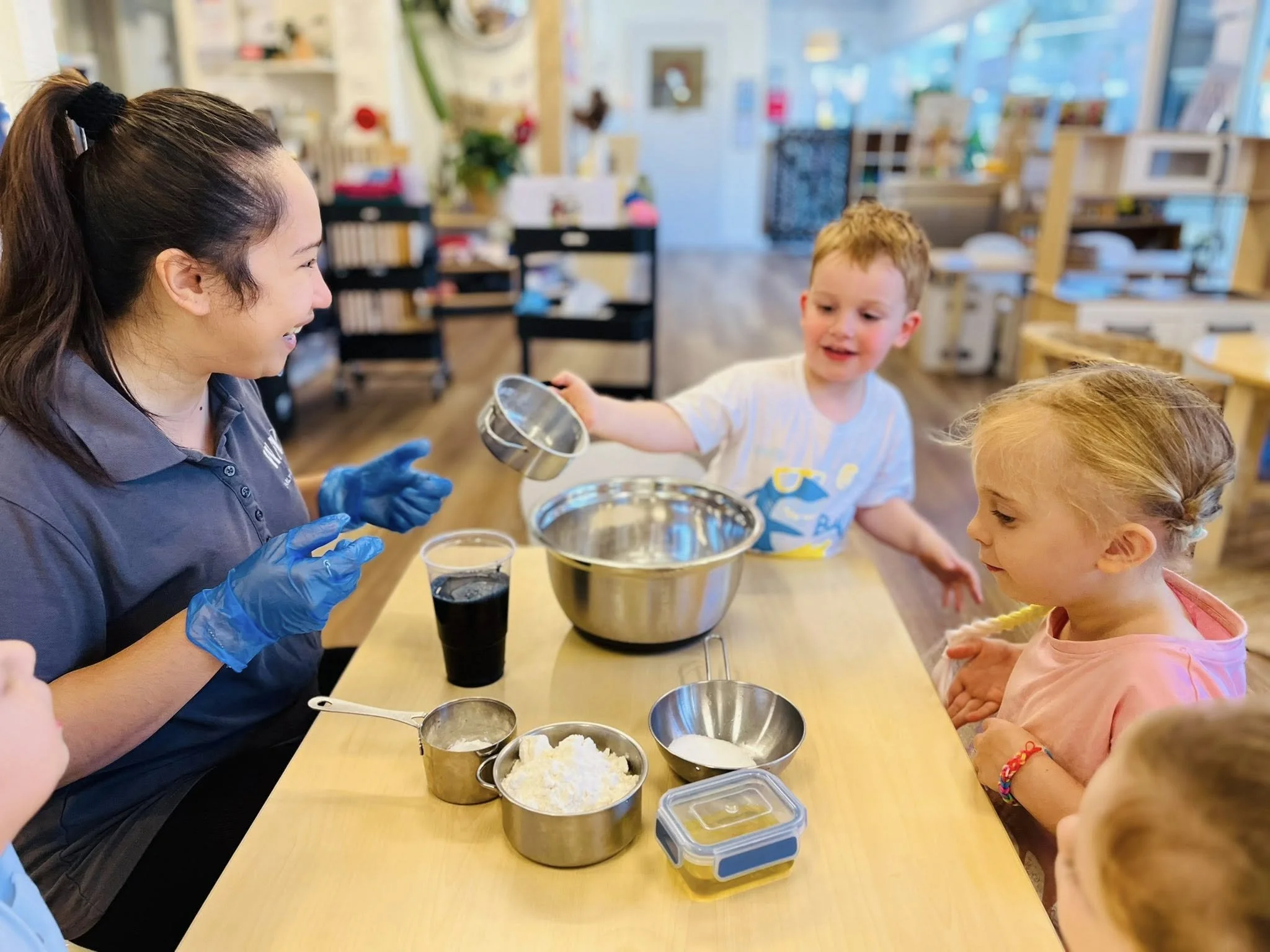
Play also builds communication and social capability
At Balgowlah Early Learning, this means educators paying attention to each child’s interests, developmental needs and participation. It means noticing when to step in, when to step back, and how to help a child feel both supported and capable.